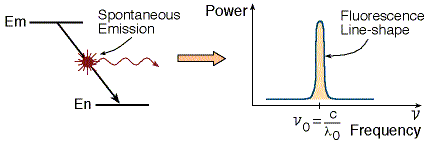
Fluorescence line-shape
Fluorescence line is described by plotting spontaneous emission radiation intensity as a function of frequency (or wavelength), for the specific lasing transition. In figure 5.1 for the He-Ne laser it was for transition between E5 and E2.
When the transition is between narrow levels, the fluorescence line is narrow.
The narrower the fluorescence line the easier (less energy required) it is to achieve population inversion.
The ideal fluorescence line-shape is a spike pulse with width approaching zero, as described in figure 5.2a.

In reality,
each energy level have a finite width, as described in figure 5.2b.
Thus, many transitions can occur between different regions in the upper
lasing level to different regions in the lower laser level. All these transitions,
plotted as a function of frequency, make the fluorescence line shape shown
in figure 5.3.